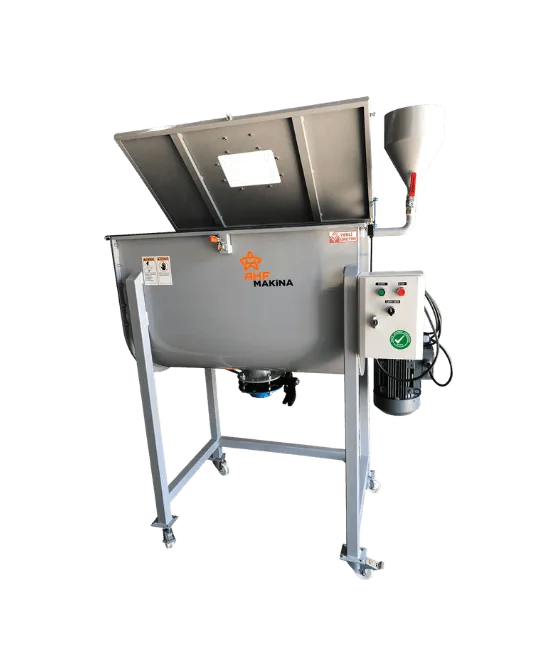
"How does a powder mixer work?" is one of the questions we get most often. The reason is usually the same: an investment decision is approaching, and people want to understand what's actually turning inside the machine in order to choose the right one. In this article, we'll try to explain the working logic of the horizontal ribbon (blade) mixer, which capacity works for which industry, and what determines the price — in plain language, more like workshop talk than a technical spec sheet.
Ribbon Mikser Tam Olarak Nedir?
It gets its name from the dual ribbon blade system rotating inside the tank. Inside a horizontally positioned cylindrical tank, there are two separate ribbons wound around a shaft: one pushes material inward, the other outward. Since the two ribbons work in opposite directions at the same time, the material moves both lengthwise and crosswise, turning into a homogeneous mixture in a short time.
It is also known in the market as a "powder and granule mixing machine." It is the most preferred equipment type for blending plastic granules, fertilizer, spices, construction chemical powder, minerals and similar dry raw materials — the reason is simple: it gives a more homogeneous result with less energy than other solutions.
Working Principle: How Is a Batch Processed?
In a powder mixer, a single mixture (batch) goes through the following stages:
- Loading: Raw material is loaded into the tank through the top lid or side feeders. The fill ratio is generally kept at around 60–80% of tank volume — neither too full nor too empty, as both reduce efficiency.
- Mixing: Once the motor engages, the inner ribbon pushes material in one direction while the outer ribbon pushes it the opposite way. This opposing motion speeds up mixing.
- Control: Duration ranges from 3–15 minutes depending on the material and the desired homogeneity level. In a well-tuned system, the coefficient of variation (CV) can drop below 5%.
- Discharge: When the time is up, the bottom lid or pneumatic valve opens, the mixture is discharged, and the tank is ready for the next batch.
Which Capacity Is Used in Which Industry?
The right capacity is determined by your daily production volume. Small-scale spice or specialty chemical manufacturers are generally comfortable with compact models in the 50–100 kg range; for large fertilizer plants or plastic raw material blenders, models of 300–500 kg and above make more sense.
The most common mistake we see in the technical consulting we provide to manufacturers in Konya and across Turkey is choosing a small capacity based on "it's enough for now" thinking. If production grows within a year or two, the small mixer becomes a bottleneck and a second investment is needed. That's why we recommend factoring your growth plans into the purchase decision.
What Determines the Price of a Powder Mixer?
There's no single answer to the "price" question because several variables come into play at once. Capacity (tank volume) is the biggest factor; next comes body material — the price difference between carbon steel, 304 steel and 316L steel can be significant. Motor power, whether or not there's a frequency inverter, options like a heating jacket, and custom discharge systems also affect the total cost.
In short, even if two mixers look similar from the outside, the material quality and equipment options inside can push the price to very different levels. So for an accurate price, the best approach is to share your production needs (material type, daily volume, industry) with us — we evaluate all of it together when preparing a quote.
Factors Affecting Mixing Efficiency
The efficiency of a ribbon mixer depends on these four points:
- Fill ratio: The tank being either too full or too empty both reduce homogeneity.
- Rotation speed: Excessively high speed can cause segregation in light powders. Adjusting rotation speed with an inverter is critical here.
- Blade geometry: Dense granules and fine powders may require different ribbon angles.
- Blade-tank clearance: The smaller this clearance, the less material remains in the tank. This detail matters in production lines with frequent color or recipe changes.
Common Maintenance Mistakes
The problem we encounter most often in the field is the cleaning door not being opened for a long time because it "already looks clean." Material that builds up at the bottom of the tank and in the corners between the blade and body eventually causes residue contamination — this becomes especially noticeable on lines with frequent color or recipe changes.
The second common mistake is neglecting the gearbox oil check. On a heavily used mixer (8–16 hours a day), if this check isn't done every 6 months, gearbox life shortens and unexpected downtime occurs. The good news: both checks only take a few minutes, and doing them regularly significantly extends the machine's life.
The AHF Powder Mixer Difference
As AHF Makine, we manufacture our ribbon mixers to order at our workshop in Konya, and we run every machine through an empty and loaded operation test before delivery. A frequency inverter is standard with us, and a CE certificate plus a Turkish-language user manual ship with every machine. If you have requests such as custom capacity, material selection or a heating jacket, we incorporate them into the design on the same line.
Another advantage of being based in Konya is fast regional service and spare parts support — this means losing hours, not days, when a machine breaks down.
Related Product: Powder Mixers →