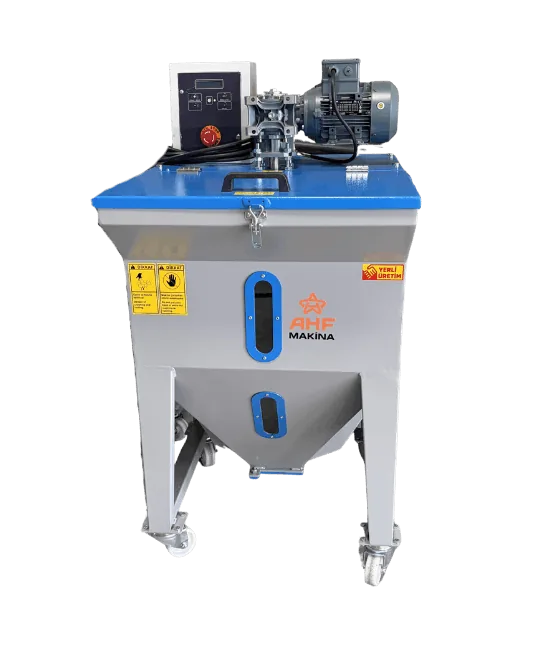
We hear the question "which raw material mixer should I buy?" from a few customers almost every week. There are dozens of brands and models on the market, prices vary widely, and every seller says "ours is the best" — confusion is understandable. In this guide, we tried to explain in plain language the 7 criteria that really make a difference when buying a raw material mixer for plastics production, along with examples we've seen in the field.
1. Capacity: Think About the Next 2-3 Years, Not Today
The most common mistake is buying a mixer at exactly the capacity you produce today. As production grows, the mixer becomes a bottleneck and a second investment is needed within a few years — which is far more costly than buying a slightly larger model from the start. Our general rule: choose a model with 30–40% more capacity than your current daily need.
2. Body Material: 304, 316L, or Carbon Steel?
304 grade steel is sufficient for most plastic raw material mixing applications. You should move up to 316L if: the mix contains acidic additives, strong chemicals are used in cleaning, or you're operating in an environment involving food contact. Carbon steel-bodied models are cheaper, but the long-term risk of rust and contamination shouldn't be overlooked.
3. Mixing Geometry: Ribbon or Propeller?
The right geometry depends on your raw material's density, granule size and mix ratio. A tilting tank + propeller-type mixer is generally ideal for blending different-sized PE/PP granules with masterbatch. On the other hand, in applications where very fine powder additives are added to high-concentration granules, horizontal ribbon geometry gives a more homogeneous result.
4. Mobile or Fixed?
If you're feeding raw material to multiple injection or extrusion machines, a wheeled (mobile) mixer offers a major advantage — instead of buying a separate fixed mixer for each machine, you move a single mixer around the factory. For a single line requiring continuous high capacity, fixed platform models generally work more efficiently.
5. Motor and Energy Efficiency
IE3 efficiency-class motors make a noticeable difference in annual energy bills compared to IE1. A frequency inverter is also important for both energy savings and precise speed control — especially if you work with fragile granules or specially surface-coated materials, this control is no longer a luxury but a necessity.
6. Ease of Maintenance and Spare Parts
A raw material mixer can run 8–16 hours a day — that's a heavy workload. Easy opening of the cleaning door, effortless access to grease points, quick lid removal; all of these prevent breakdowns and shorten cleaning times. Spare parts are also critical: with a mixer purchased from Konya-based AHF Makine, most critical parts are kept in stock, so spare parts typically reach you within 1–3 business days.
7. Total Cost of Ownership, Not Just Price
Looking only at the sticker price can be misleading. Calculate energy consumption, maintenance cost, spare parts prices and expected lifespan together — we call this total cost of ownership (TCO). A mixer that looks cheap at first glance can end up costing more than a quality alternative within 3 years due to frequent breakdowns and expensive spare parts.
Why Do Raw Material Mixer Prices Vary So Much?
Some of our customers say "same capacity but very different prices" — the reason is that each of the 7 criteria above is reflected in the price to a different degree. Body material (304/316L/carbon steel), motor power and presence of an inverter, mobile chassis, and options like a heating jacket directly affect the total cost. If you see a big difference between two quotes, compare these line items first; often the difference isn't in the price, it's in the content.
Conclusion
Choosing a raw material mixer is really an investment in your production efficiency. Correctly defining your technical requirements and buying from a reliable domestic manufacturer is the right decision in the long run. As AHF Makine, we provide free technical consulting on raw material mixer selection — if you're near Konya, you can visit our workshop and see the machines in person.
Related Product: Plastic Raw Material Mixers →