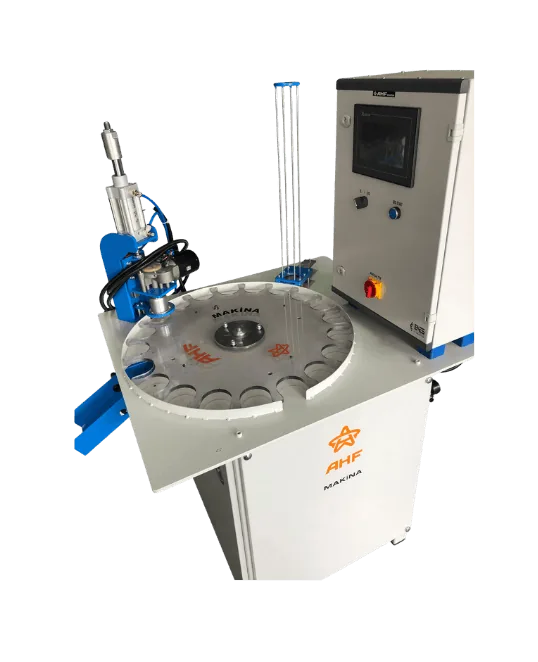
When capping is done manually on a bottle, jar, or canister production line, both labor cost and the risk of capping errors increase. The right cap assembly machine removes one of the biggest bottlenecks on the line and multiplies hourly production capacity. In this guide, we outline the criteria to consider when choosing a cap assembly machine.
Cap Type and Size Compatibility
Screw caps, flip-top caps, pump heads, and spray trigger caps all require different sealing mechanisms. Before buying a machine, be sure to ask whether all the cap types you use have been tested and how quickly the head can be changed over.
Line Speed and Number of Stations
Standard single-station machines can cap 20-40 bottles per minute, while dual-station models can push that figure up to 60-90 bottles. Calculating your actual capacity requirement by dividing your daily production target by hourly capacity — rather than guessing — prevents both over-investment and insufficient capacity.
Torque Setting and Sealing Precision
A cap that's too loose risks leaking during transport; one that's too tight risks cracking the bottle neck. Machines with digitally calibrated torque settings deliver consistent results across different cap/bottle combinations — a critical feature especially for facilities running multiple product lines.
Automation Level: Semi-Automatic or Fully Automatic?
Semi-automatic desktop models are sufficient for low-to-medium volume production, while fully automatic systems with conveyor integration are preferred for continuous line production. On fully automatic lines, the compatibility of additional modules such as the cap feeding hopper, bottle alignment sensor, and reject station should also be evaluated.
Materials and Ease of Maintenance
For facilities in the food and cosmetics sectors, a stainless steel machine body, easy-to-clean surfaces, and a fast head-changeover mechanism matter for hygiene compliance. Being able to source spare parts from a domestic manufacturer also shortens maintenance downtime.
Conclusion
Choosing a cap assembly machine requires evaluating cap type, target line speed, torque precision, and automation level together. At AHF Makine, we offer custom configurations for our standard and dual-station models based on your production line's capacity, along with on-site support after installation.
Related Product: Plastic Cap Assembly Machines →